
Humans of NHC: Meet Mary, Program Director at the Homeless Youth Alliance!
My name is Anoushka Rustagi and I’m a member of the National Health Corps, San Francisco, serving as the Ending the Epidemics Coordinator for Whole Person Integrated Care, a program of the Department of Public Health. A major part of my role is to improve access to STI screenings and sexual health information at off-site locations, including shelters and community clinics.
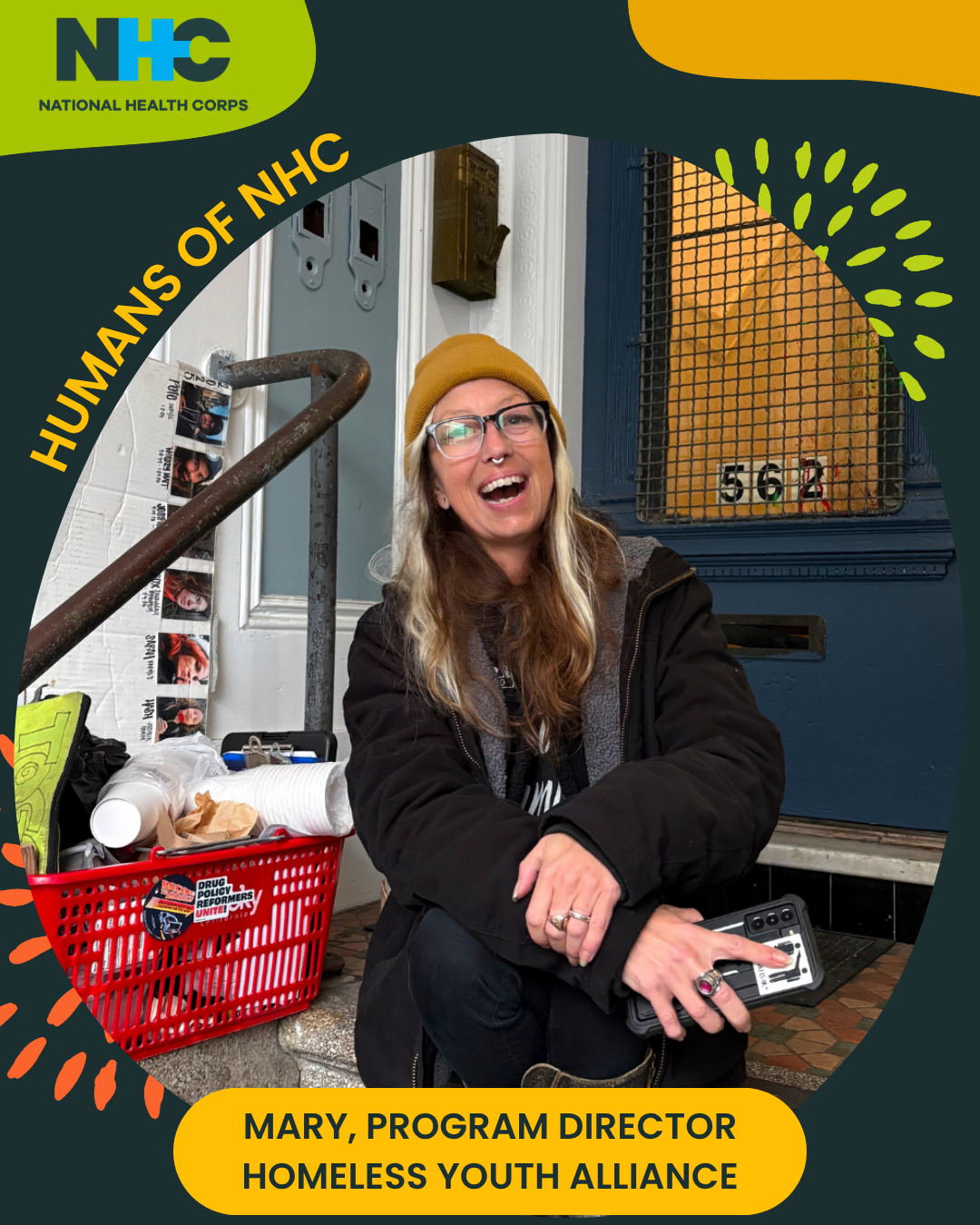
One of the highlights of my service term has been working at the Homeless Youth Alliance (HYA) free clinic. HYA is run by a fierce and funny woman named Mary. Mary has run the Homeless Youth Alliance (HYA) since 2006, and in the years since, HYA has seen a global pandemic, changes in the policy landscape, and increasing public attention to homelessness.
Walking into the upstairs clinic, I finally caught ahold of Mary for our hastily scheduled interview. She sat down, looked at her phone, and promptly said, “Okay, I have about 15 minutes.” We got right to it, beginning to speak about Mary’s own backstory and her motivations for getting involved with HYA. Mary recounted that she ran away from home at 14 to San Francisco’s Tenderloin, but didn’t trust any of the youth services available. “I really wanted to create a space I would’ve used when I was on the street.”
HYA started out as a small grassroots organization that was mostly volunteer-run, and it has since expanded to have a full staff offering medical care, mental health services, shelter programs, and more. “My vision was never to get big,” Mary explained, “I think when organizations get too big they lose their magic. I’m all about quality over quantity.” One of HYA’s points of pride is that it’s a peer-led program- several staff and volunteers have had personal experiences being unhoused.
Some of Mary’s favorite memories around HYA revolve around seeing clients who the program made such a big difference for. Beaming, she told me, “Recently I was at the General Hospital and there was a nurse practitioner there who was a participant I case managed, when they were really young and [using] drugs… Everywhere I go, I’ll run into people, and I’ll get texts from all over the country that are like ‘I met a person who said you saved their life when they were a teenager.’” For Mary, “watching how people’s lives get to change when they have meaningful relationships and services” has kept the soul of the work alive.
Recently, HYA has faced several challenges, including backlash about the services it provides to unhoused folks. I asked Mary what she thought some of the most pressing issues were that threatened this work. She explained, “The amount of time and energy people put into criminalizing and fighting people who are poor instead of poverty itself… that’s the real crime. We’re all on the same side. No one wants to see people living outdoors.” Mary emphasized that dialogue between administrations and the people who have direct experience serving these populations is the only way forward.
I ended by asking Mary for her vision of what healthcare for the homeless looks like, and what lessons our members could take away from serving vulnerable populations. “I think it’s really about asking people what works for them and what doesn’t, not necessarily only believing what you’re taught. I train doctors and I’ll always start every training by asking people to raise their hand if they’ve ever lied to a doctor. And every doctor raises their hand, and the reason that happens is because everyone feels judged. There’s a reason people come here and it’s because we do really well at listening to people and treating them with respect.”
As Mary would put it, the magic isn't in the size of the organization or the scope of the program - it's in whether people feel heard and safe enough to show up as their true, whole selves. Twenty years later, that's still the whole point.
About the Author